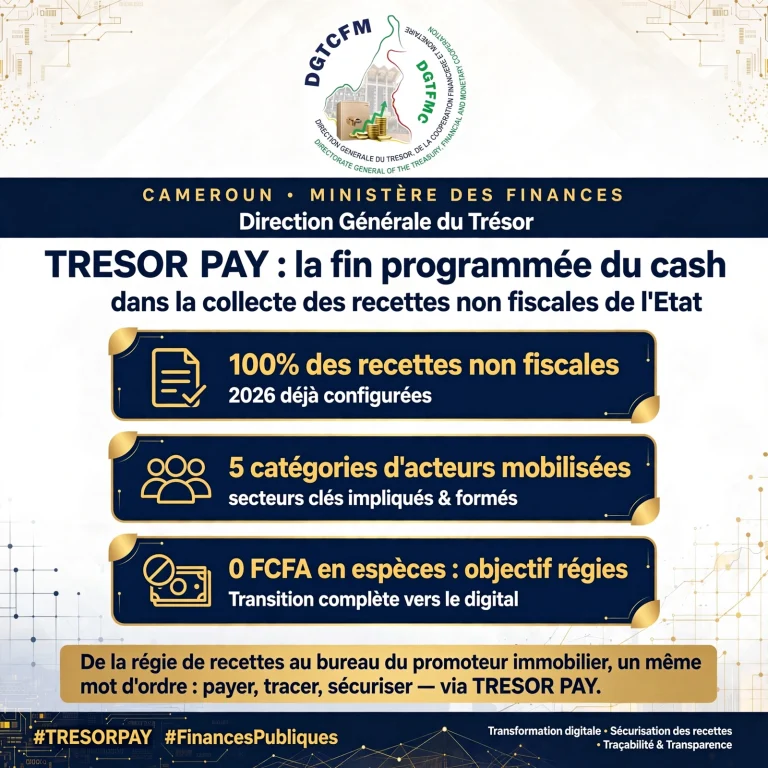
TRESOR PAY: the programmed end of cash in the collection of the State's non-tax revenue
In a note addressed to the entire Treasury accounting network, the Director General of the Treasury, Financial and Monetary Cooperation gives the final push: every franc of non‑tax revenue must now be processed through the electronic platform TRESOR PAY. No more cash, only traceability.
📌 An instrument born from a clear political will
TRESOR PAY is not just another IT tool: it is the single electronic platform established by Order of the Prime Minister, Head of Government, for the collection of State revenues and the payment of public expenditure. As part of the implementation of the 2026 Roadmap of the Ministry of Finance, the Head of Government instructed the strengthening of non‑tax revenue mobilisation, which is expected to contribute more to the financing of the State Budget.
The finding that prompted the Director General's note is unequivocal: although the platform is now fully operational and all non‑tax revenues provided for in the 2026 Finance Act are configured on it, some revenue collectors continue to collect in cash. A practice that the DGTCFM intends to eliminate, because it weakens revenue security, opens the door to losses, and hinders collection performance.
📋 A mobilisation at all levels of the accounting network
The note is addressed directly to the Paymaster General of the Treasury, the General Paying Treasurers, the Specialised Paymasters, the accountants of special allocation accounts, and the collectors of state land revenues. Each receives the same roadmap:
- Identify all collection units under their territorial or functional jurisdiction;
- Verify their effective capacity to use the TRESOR PAY platform;
- Support collectors and agents in mastering electronic collection procedures;
- Regularly monitor revenues collected via the platform;
- Report without delay to the DGTCFM any technical, organisational or procedural difficulties.
🔍 Control in the wings: verification missions announced
The generalisation will not be achieved on goodwill alone. The Treasury Audit Department will carry out control and verification missions across all financial jurisdictions, with a threefold objective: confirm the effective use of the platform, reconcile revenues generated with those recorded in TRESOR PAY, and detect any cash collections that remain. Transaction traceability thus becomes the new accountability standard for the public accounting network.
🏗️ On the ground, the switch is already underway
The DGTCFM's call is not theoretical: other administrations are already coming on board. The Ministry of Housing and Urban Development has just informed real estate developers, estate agents and condominium trustees of the launch, on www.tresorpublic.cm, of electronic payment for several professional fees: developer approval, professional card for estate agents or condominium trustees, fire safety approvals, sanctions and penalties, and application fees for the entrance exam to the African School of Architecture and Urban Planning (EAMAU).
In practice, this means that these fees, previously payable over the counter, are now exclusively payable on the electronic platform. A strong signal: the generalisation of TRESOR PAY goes beyond the Treasury's sole perimeter and is gradually establishing itself as the single payment channel for administrative services across sectors.
💡 Why this reform matters
By securing each transaction, making it traceable end‑to‑end and centralising information at Treasury level, TRESOR PAY changes the very nature of the relationship between the user, the revenue collector and the State. Less cash handling means less risk of loss; more real‑time data means better budget visibility; a single platform means a more transparent public service for both taxpayers and investors. This is the whole challenge of the modernisation of Cameroonian public finances undertaken by the Ministry of Finance.
From the revenue collector's office to the property developer's desk, one guiding principle: pay, trace, secure — via TRESOR PAY.
Source: Directorate General of the Treasury, Financial and Monetary Cooperation (DGTCFM) – Guidance note on the generalisation of TRESOR PAY for non‑tax revenues, July 2026.
DGTCFM Communications – July 2026.